Water is the system constraint
Fresh, clean water must remain available to poultry throughout winter. Utah State University Extension describes water as the nutrient chickens consume in the greatest quantity and notes that inadequate water reduces feed intake and can affect growth and egg production. A frozen drinker is therefore more than an inconvenience: it breaks the feeding system.
Do not wait for a severe cold snap to discover how fast the current container freezes, how long refilling takes, or whether timid birds are crowded away. Test on an ordinary cold morning. Record the outside temperature, time since the previous check, water condition, amount added and whether every bird drank. That field record gives you a real baseline instead of a product-size guess.
Choose the operating model first
Manual swap
Carry fresh water on a fixed schedule and exchange frozen or near-frozen containers. It avoids electrical equipment in the coop but depends on reliable labor, a thawing location and enough duplicate containers.
Heated unit
Use equipment specifically approved for poultry or livestock and the environmental conditions. It can reduce freeze-ups, but adds cord routing, load, moisture and fire-safety requirements.
Protected line
A plumbed system may serve a larger flock, but every exposed line, valve and nipple becomes a freeze point. Pressure control, drainage, maintenance access and an independent backup still matter.
The best model is the one the household can inspect every day and restore quickly after a failure. A complex system without parts or a simple bowl without a dependable swap schedule both leave the flock exposed.
Size with observations, not a headline capacity
Published container capacity does not tell you how much usable water remains after spills, freezing, contamination and competition. Start by measuring actual refill volume for several cool-weather days. Note flock size, age, production stage and weather. Then add margin and a second access point so a leak, dominant bird or tipped container does not remove the only source.
Utah State recommends extra drinker capacity beyond estimated consumption so a spill or leak does not immediately exhaust the supply and less dominant birds have another place to drink. Treat any example gallon-per-bird figure as a planning reference, not a promise: intake varies with feed, temperature, bird type and management.
| Question | Evidence to collect | Pass condition |
|---|---|---|
| Enough usable volume? | Measured refill volume and remaining water at each check | Water remains available until the next scheduled visit |
| Enough access? | Observe flock at peak drinking time | Smaller and lower-ranking birds drink without prolonged crowding |
| Stable placement? | Push test on the serviced base | No rocking, tipping or bird-level obstruction |
| Dry surroundings? | Inspect litter and floor beneath and beside the unit | No persistent wet patch, icing or runoff into bedding |
Control water before it controls the coop
Winter moisture comes from respiration, manure and spilled water. University of Minnesota Extension notes that chicken manure is roughly 70 percent water and emphasizes ventilation and manure management for moisture control. A leaking waterer adds to that load, wets litter and can form ice where people and birds walk.
- Set the waterer on a level, cleanable base that does not trap runoff.
- Keep the drinking height appropriate as birds grow; follow the equipment instructions.
- Choose a design that can be opened, scrubbed and rinsed without carrying contamination into the household kitchen.
- Inspect seals, nipples, trays and valves under operating pressure rather than only when empty.
- Keep feed and bedding from being kicked into open water.
- Clean poultry water equipment outdoors when possible and wash hands after contact with birds, bedding, feed or water containers.
University of Maine’s 2026 backyard-poultry food-safety guidance recommends handling water and feed containers outside as much as possible to reduce cross-contamination into homes. Build cleaning access into the buying decision: an awkward reservoir will not become easier to sanitize in freezing wind.
Audit electricity as a complete route
Do not review only the heater label. Trace power from the panel and receptacle to the plug, cord, connection, unit and surrounding litter. University of Minnesota Extension advises keeping wires away from poultry, water and flammable litter and using extension cords only short term. It also says to choose equipment approved for use around chickens and livestock and follow installation and fire-risk instructions.
- Verify the use case. Confirm the product is listed by its maker for the location, animal environment, waterer type and expected temperature. Indoor-only equipment does not become outdoor equipment under a bucket.
- Confirm the circuit. Have a qualified electrician address receptacle protection, outdoor or wet-location suitability, circuit capacity and permanent wiring. Do not guess from plug shape.
- Protect the path. Route cords where birds cannot peck them, rodents cannot chew them, people cannot trip, and water cannot run toward a connection.
- Keep combustibles clear. Follow the manufacturer’s required spacing from litter, wood, dust and other combustible material.
- Inspect every day. Stop using equipment with heat damage, cracks, loose connections, exposed conductors, repeated breaker trips or unexplained loss of power.
Build a backup that shares no single failure
If the primary plan depends on electricity, the backup should work during an outage. If the plan depends on twice-daily carrying, the backup needs another capable person and staged containers. Keep duplicate clean vessels where they will not freeze solid before use. Record the nearest safe water source and the amount that can be transported per trip.
Run a failure drill before winter: turn the primary unit off, start the clock and use only the backup. Can the household supply every bird, keep the coop dry and reset the primary system without rushing? The result may show that the missing “part” is a second bucket, a better cart, a labeled shutoff, a brush that reaches the corners or a phone number for help.
The first-freeze buying brief
Before requesting a quote or choosing a model, write the requirements below. This turns vague shopping into a specification that manufacturers and authorized dealers can answer.
A product description that omits these facts is not complete enough for a winter system. Ask for current documentation rather than relying on reviews from a different climate, flock or installation.
Use a two-minute daily ledger
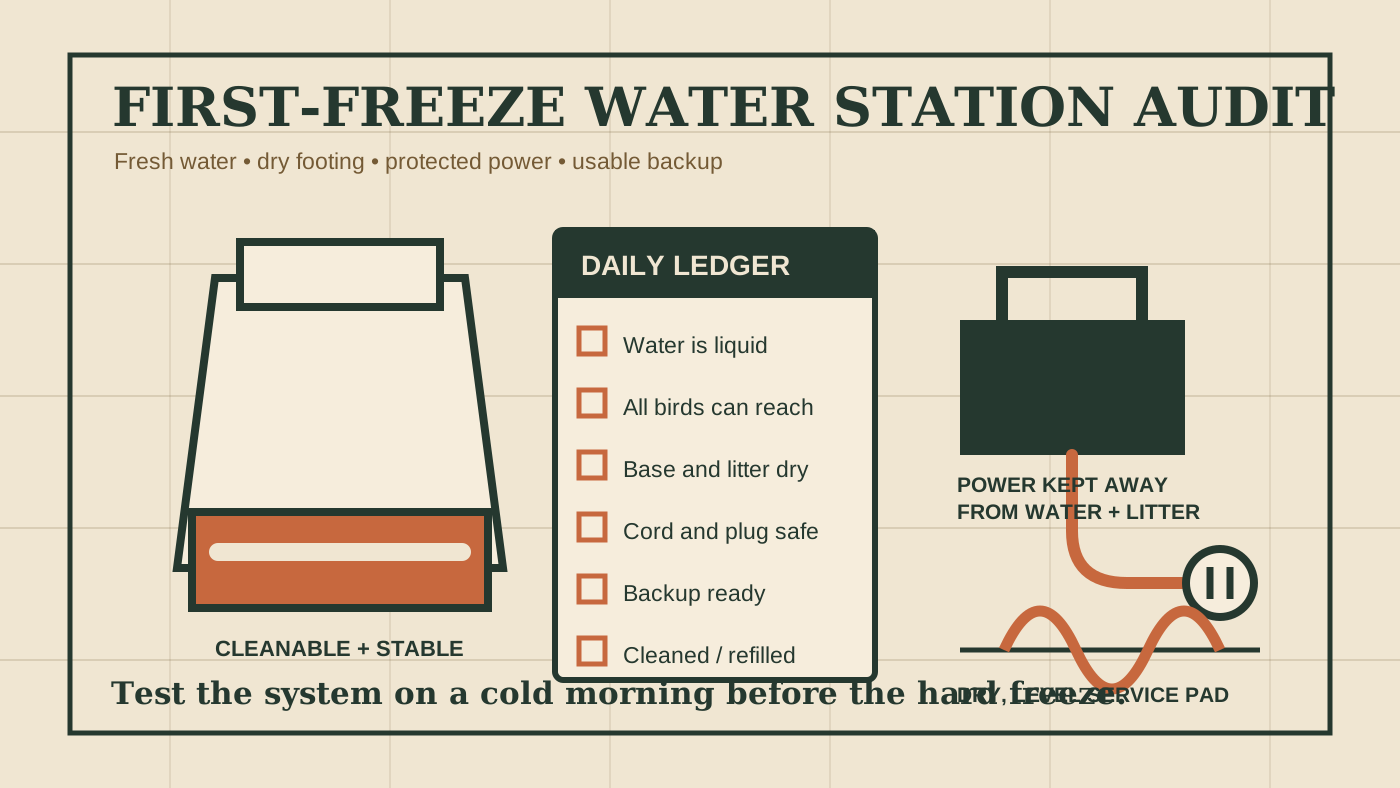
At the morning and evening check, record whether water is liquid, clean and reachable; whether the base and nearby litter are dry; whether the cord, plug and unit look normal; and whether the backup remains ready. Add refill volume and the lowest temperature. A week of notes will reveal patterns such as one nipple freezing first, a capacity shortfall, recurring wet litter or a circuit that fails only under another load.
After a storm or outage, review the sequence rather than only resetting the equipment. Record when the failure began, when it was noticed, how long the backup took and which supply or instruction was missing. That repair note is more valuable than buying another device without identifying the weak link.
For the garden, greenhouse and yard supply, pair this livestock check with the garden irrigation winterization ledger.
Sources checked
- University of Minnesota Extension: Caring for Chickens in Cold Weather
- Utah State University Extension: Principles of Feeding Small Flocks of Chickens at Home
- University of Maine Cooperative Extension: Best Management Practices for Small-Scale Poultry Producers
- University of Maine Cooperative Extension: Backyard Poultry and Food Safety, June 18, 2026.
- University of Maine Extension: Winter Watering Tips.
Research reviewed September 28, 2026. Follow current manufacturer instructions, electrical codes, veterinary guidance and local Extension recommendations.