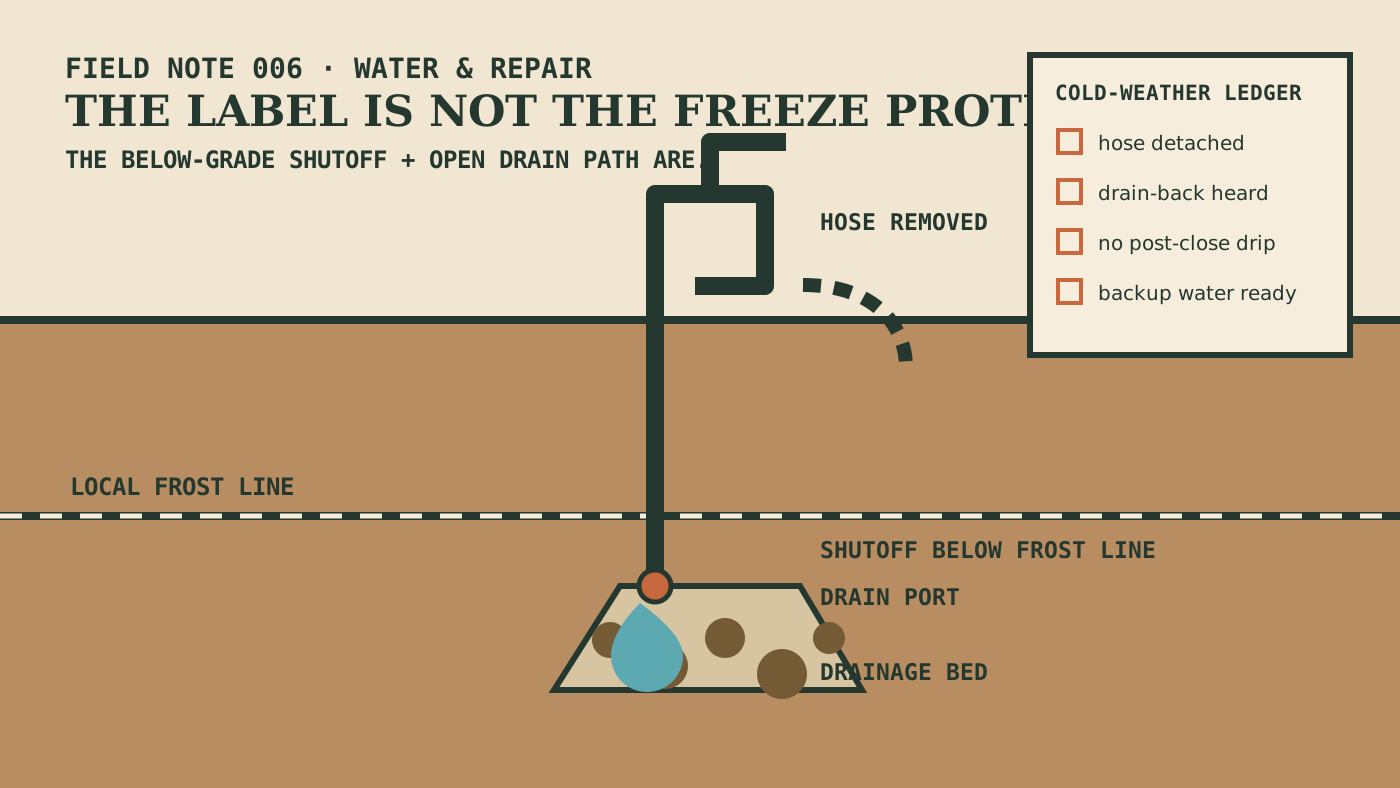
The freeze protection is below ground
A typical frost-free yard hydrant does not keep its standpipe warm. Closing the handle moves a plunger or valve at the bottom, ideally below the local frost line. The supply closes there, and water in the vertical standpipe exits through a drain port into a gravel bed or another approved drain arrangement. Air must enter at the outlet for that water to leave.
Woodford's installation guidance describes the same chain: the valve and drain hole sit below frost depth, the drain field needs space and washed gravel, and saturated soil can prevent drainage and lead to freezing. Indiana's health department describes drain-back hydrants as sending standing water through a weep hole to a gravel bed or tile drain below frost depth.
That is why the words on the casting are not enough. A hose with a closed nozzle can hold a vacuum. A blocked or submerged drain port can leave the pipe full. A worn plunger can let supply water seep back after drainage. A hydrant installed too shallow for the site, or without a working drainage zone, may have no dependable freeze protection.
An eight-step pre-freeze inspection
1. Identify the exact model and water use
Photograph the head, handle, casting marks and label. Find the current installation and service instructions. Record whether the line supplies potable household water, livestock water, irrigation or a non-potable system. Note who installed or last repaired it. Adjustment, bury depth, plunger and seals are model-specific; a generic adjustment can trade a visible leak for a hidden one.
2. Map what is hidden
Mark the supply route, isolation valve, documented bury depth, local frost-depth design value, drainage-bed location and nearby electrical, septic, fuel, pesticide or manure areas. Note whether runoff pools around the riser. Frost depth and plumbing rules are local design inputs, not values to copy from a national chart. If buried details are unknown, write “unknown” rather than guessing.
3. Remove every downstream attachment
Disconnect the hose, splitter, quick-connect, timer and spray nozzle. Simmons' instructions warn that leaving a hose attached can prevent drainage and cause freezing. The principle applies even when a hose seems empty: a closed nozzle or low loop can block air movement. Drain and store the hose where it cannot refill with rain or snowmelt.
4. Run the hydrant under normal pressure
Open it fully using the normal handle motion. Check useful flow, then look and listen for leakage at the packing nut, head, linkage and riser. A wet patch that grows while water runs, new erosion, bubbling or a loose riser needs investigation. Clear water does not prove water quality; after flooding, plumbing work or a cross-connection, follow the water supplier or health authority's sampling instructions.
5. Close once and observe drain-back
Close normally; do not slam the handle or add leverage. With the outlet unobstructed, listen near the spout. Many models make a short suction or draining sound. Record what you hear and approximately how long it lasts, but do not impose a universal drain time. Pipe length, diameter, installation and model differ. A change from the hydrant's established behavior matters more than an internet stopwatch value.
6. Watch the spout after closing
A few residual drops may be ordinary, but a continuing drip can mean the below-grade valve is not sealing. Water that keeps entering the standpipe can freeze even if the drain port is open. Record the air temperature and whether the drip stops. Do not tighten linkage at random to cure a below-grade problem.
7. Check ground and support
Look for a leaning head, rocking riser, damaged handle stop, corrosion, vehicle damage, settlement, standing water, ice lenses and unexplained soft soil. Woodford tells installers to support the hydrant and provide drainage; movement can stress the buried connection, and saturated drainage material can defeat drain-back.
8. Stage a backup water route
For livestock, a hydrant outage becomes an animal-care problem. Penn State's current winter farm-work guidance emphasizes dependable water and backup planning. Calculate one normal chore cycle, identify a clean transport container and safe route, and decide how water will remain usable during an outage. Do not rely on a distant frozen hose.
Separate a monitor item from a stop-use signal
| Observation | What it may mean | Next action |
|---|---|---|
| Consistent drain sound; dry spout afterward | Drain-back appears to operate | Record baseline; keep attachments removed |
| No sound or a sudden change | Blocked air path, drain obstruction, saturated bed or model difference | Check exact manual; arrange qualified inspection |
| Spout keeps dripping | Below-grade valve may not seal | Isolate if approved and call before a freeze |
| Water or ice at base | Buried leak, poor drainage or runoff | Stop use if a leak is suspected; protect area and call |
| Changed handle motion | Linkage, adjustment, obstruction or freezing | Do not force it or add a cheater bar |
| Riser rocks or leans | Support or buried connection may be compromised | Keep vehicles and livestock away; obtain service |
If a dedicated, labeled isolation valve can be operated safely and system instructions permit it, isolate a suspected leak. Never shut a shared farm or household supply without knowing what else it serves. Do not enter a well pit or confined space, and do not excavate until utilities and private lines are located.
Keep the drinking-water line out of the trough
A hose submerged in a stock tank, pesticide mixture, sprayer or dirty bucket creates a cross-connection. A pressure drop can pull non-potable water backward. EPA guidance identifies submerged garden hoses and chemical sprayers as backsiphonage risks. Its manual explains that hose-bibb vacuum breakers serve specific applications; correct protection depends on the hazard, pressure conditions and local code.
- Keep the hose outlet above the receiving vessel with a visible air gap.
- Never connect a potable hydrant to a chemical injector without protection required by the label, water authority and plumbing code.
- Use only an approved, correctly installed backflow device for the actual hazard; backsiphonage protection may not stop backpressure.
- Have testable assemblies inspected on the schedule required by the authority having jurisdiction.
If contaminated water may have entered the system, stop consuming it and contact the water supplier or local health authority. Flushing alone is not a universal remedy.
A cold-weather hydrant record
Complete this record during a normal check and after the first meaningful cold spell. Printing it gives the repair person a useful baseline.
Hydrant ID: ____________________
Date/time: __________ Air temperature: __________
Model/casting: ______________________________
Water use: ☐ potable ☐ livestock ☐ irrigation ☐ non-potable
Documented bury depth: ______ Local design frost depth: ______
Drain observation: __________________________________________
Leak/ground observation: ___________________________________
Repair action and service contact: ___________________________
The repair brief
A replacement part is not interchangeable because it looks similar. Take these facts to a supplier or contractor:
- brand, model, casting marks and current manual;
- pipe size, thread, connection and verified bury depth;
- local frost-depth requirement and drainage conditions;
- static and operating pressure, measured appropriately;
- potable or non-potable use and required certifications;
- backflow protection required for connected use;
- replaceable packing, linkage, plunger and valve parts;
- manufacturer adjustment procedure, warranty and support;
- installer qualifications, utility-location plan and commissioning checks.
Homesteading Supplier does not show prices, inventory, availability or checkout because authorized supply relationships and current commercial terms have not been established. Use this brief to compare documented fit and serviceability—not marketing shorthand.
Questions people ask before the freeze
Can it freeze anyway?
Yes. The standpipe must empty after every use. An attached hose, blocked drain, saturated bed, leaking valve or unsuitable installation can leave water where it freezes.
Should I leave the handle partly open?
Use the exact instructions. A drain-back hydrant normally needs its below-grade valve fully closed to open the drain path. An improvised half-open position may keep water flowing.
What if it is already frozen?
Stop forcing the handle. Protect people and animals from slippery overflow, switch to backup water and call a qualified professional. A thaw without diagnosis can reveal a split pipe or start a buried leak.
Connect the water ledger
Use the garden irrigation shutdown guide for hoses, timers, filters and rain barrels. If the hydrant serves a flock, pair it with the winter poultry water audit so delivery, daily drinking equipment and outage backup are planned together.
Sources checked
- Woodford Manufacturing: Yard Hydrant Installation
- Woodford Manufacturing: How a Frost-Proof Yard Hydrant Works
- Simmons Manufacturing: Yard Hydrant Instructions
- Indiana Department of Health: Policy on Frost-Free Hydrants
- British Columbia Ministry of Agriculture: Frost-Free Hydrants
- U.S. EPA: Cross-Connection Control Manual
- U.S. EPA: Cross-Connections and Backflow
- Penn State Extension: Prepare for Winter Farm Work
Research reviewed November 3, 2026. Follow current instructions for the exact hydrant, local plumbing and well rules, water-supplier requirements and qualified professional guidance.