Begin with the containment plan
An electric fence is usually a behavioral barrier, not a physical wall. Penn State Extension describes temporary electric fencing as a psychological fence. Before touching the system, move livestock to a secure pen, close a dependable interior gate, or assign a second person to animal control.
Walk the public side first. Replace missing warning signs where required, keep the energized line away from gates people must handle, and note any sagging wire near roads, shared paths, metal pipe, water systems or buildings. Missouri Extension warns that fence faults can energize metal equipment and that ordinary building wire is not rated for fence-charger pulse voltage. A damaged mains cord, scorched enclosure, wet receptacle, repeated breaker trip, stray voltage on plumbing or unexplained shocks at a barn are stop-work conditions for a licensed electrician or the utility.
Do not share a fence ground with the electrical service, utility pole or another grounding system. Locate buried utilities, private power, fuel, water and communications before driving or moving any rod. Grounding distances, lightning protection and electrode layouts vary across manuals and local rules; use the current instructions for the exact energizer and the authority having jurisdiction.
Make four readings repeatable
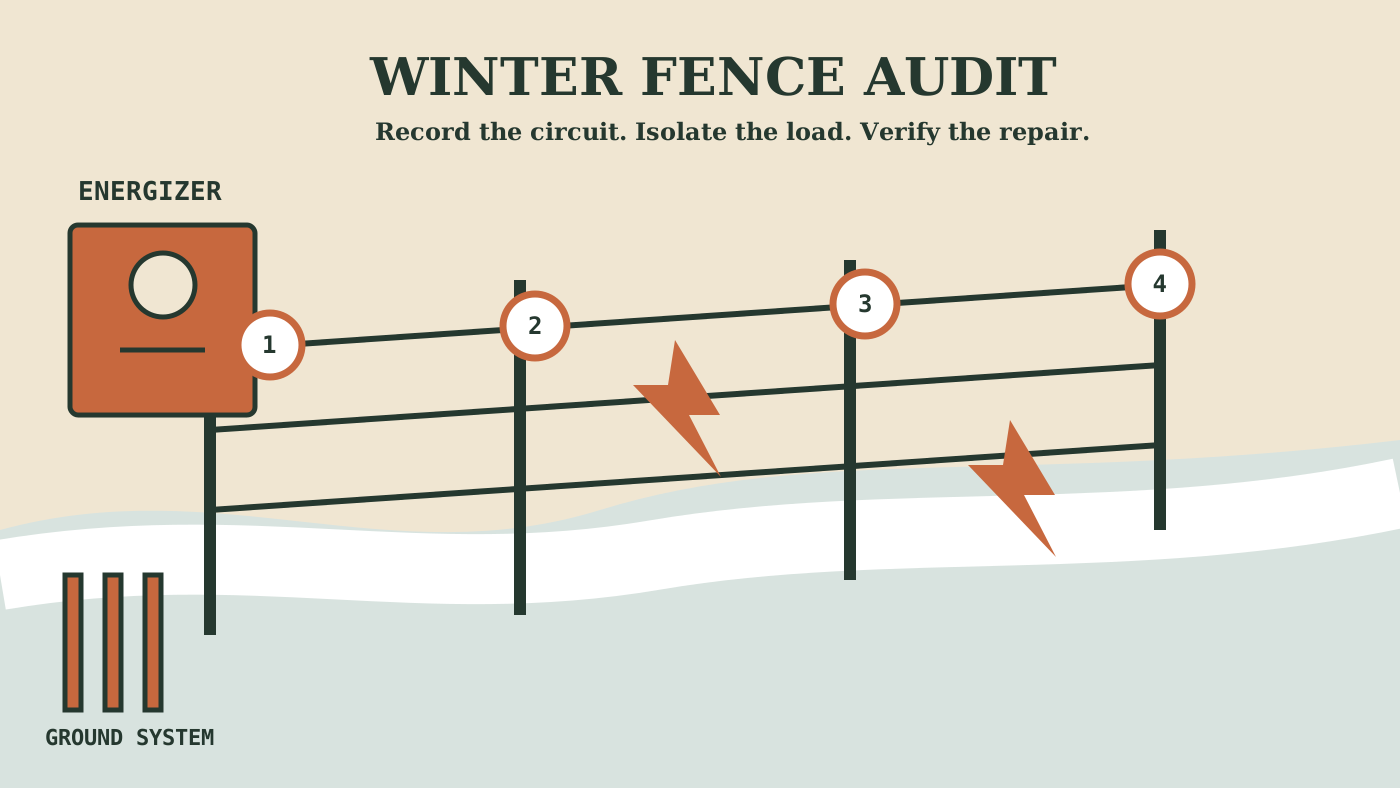
Use a digital fence voltmeter or fault finder rated for the energizer. Record its model, battery condition and the maker's instructions. Do not test by touch, with a grass stem or with a household multimeter. Then mark four permanent points:
- Energizer output, isolated as the manual directs. This separates the power unit from fence load. If it cannot meet documented output with the fence disconnected, investigate supply, battery, solar charging and service status before blaming the line.
- Fence start. Measure where the lead-out joins the fence. A large loss before this point focuses attention on lead-out cable, switches, connectors and gate feeds.
- Midpoint or major junction. Pick a place you can find after snowfall. The change from the start shows what the first half adds to the load.
- Far end. The final reading exposes a distant open conductor, poor joint or accumulated leakage.
Take all readings with the same tester, at roughly the same load, and note weather and soil conditions. Compare them with the manual's loaded-fence specification and the recommendation for the animals being contained. Species, hair coat, geometry, conductor resistance and predator pressure matter, so a number copied from a forum is not a commissioning standard.
| Pattern | Likely search area | Next check |
|---|---|---|
| Low isolated output | Energizer, mains supply, battery or solar charging | Follow maker diagnostics; service rather than bypass protection |
| Good output, low at fence start | Lead-out, cutoff switch, terminal or gate cable | Inspect rating, connections and insulation |
| Sharp drop after one junction | Fault or open circuit in that branch | Open section switches and retest one branch at a time |
| Gradual loss along line | Vegetation, snow contact, weak joints or resistant conductor | Walk and log each load; inspect splices |
| Changes with freeze or thaw | Earth return, wet snow, ice or intermittent contact | Test the ground system by the maker's method |
Treat grounding as part of the circuit
When an animal touches a hot conductor, the pulse must return to the energizer. NRCS guidance says many failures come from inadequate grounding, dry soil or rods that do not reach useful moisture. Frozen or dry surface soil can weaken an earth-return fence even when the hot wire reads normally with no animal load.
Do not diagnose grounding by looking at a rod. Use the ground-system test in the energizer manual, which typically creates a controlled load and measures voltage on the ground system. The procedure and acceptable reading are manufacturer-specific. If the test fails, record the number of electrodes, material, spacing, depth, clamps, corrosion, soil and distance from other electrical grounds. Never mix metals casually: NRCS notes that dissimilar metals can create corrosion and recommends compatible rod, clamp and conductor materials.
Some winter designs alternate hot and grounded conductors so an animal touching both completes the circuit when snow or frozen soil limits earth return. That is a system design, not a midstorm improvisation. Conductor spacing, polarity, electrode connections, energizer capacity and animal exposure all require a documented plan from the manufacturer or a qualified fence professional.
Walk the line after frost, wind and snow
Carry the tester, insulated tools approved by the manufacturer, flagging, a camera and the printed record. Start at the energizer and move in one direction. Never step over an energized wire; use a proper gate. Record each symptom:
- Snow and ice: flag buried bottom wires, drifted corners, ice-loaded polywire, pulled posts and conductors touching grounded hardware. Wet snow may add load; deep dry snow can reduce animal earth contact. The result depends on the system.
- Vegetation: remove branches and dead growth only after de-energizing as directed. Penn State and Missouri Extension identify plant contact as a source of shorts or voltage loss.
- Insulators: look for cracks, carbon tracks, wire cut-through, loose fasteners and arcing marks. Moist wood can conduct; wire should not simply wrap a post.
- Connections: inspect clamps, crimps, jumpers and tensioners. Knots in polywire and improvised twists can create resistance or hide broken filaments.
- Gates: verify that rated insulated cable, not the detachable handle, carries power across the opening. Protect buried cable from traffic.
- Solar and battery units: clear the panel without scratching it, document shade, inspect cables, and test the battery only by the maker's method. A buried wire can load the system faster than weak winter sun replenishes it.
- Lightning protection: inspect—not improvise—the arrestor, choke, surge protection and separate grounding specified by the manual.
Find the fault by dividing the fence
If voltage is low, switch the energizer off as instructed and open one labeled cutoff or disconnect one documented branch. Re-energize, stand clear and retest the same point. A strong recovery means the removed branch contains most of the load. Divide that branch again. This half-split method is faster and more defensible than replacing random parts.
When a branch is isolated, arcing may click or show after dark. Observe only from a safe position. Never approach a suspected arc in dry vegetation, a barn, or near fuel. Shut down and address fire risk. If no single branch explains the loss, add the small loads: damp vegetation, corroded connections, resistant polywire and inadequate grounding can combine.
After repair, restore every connection, confirm gates and signs, then repeat all four baseline readings. Walk the animal side before release. Record the numbers; “seems stronger” is not a closeout test.
Winter fence test and repair record
Print this page and keep one sheet at the energizer. Recheck after a storm, hard freeze, thaw, branch fall or animal breach.
Fence ID: ____________________ Date/time: __________
Weather/snow/soil: ________________________________________
Energizer model/output specification: ______________________
Tester model: __________________ Battery/solar status: ______
Isolated energizer output: ______ kV
Fence start: ______ kV Midpoint: ______ kV Far end: ______ kV
Ground-system test reading/method: _________________________
Fault location and repair: _________________________________
Post-repair readings: _____________________________________
Parts/service follow-up and date: __________________________
Write the repair brief before buying
Bring a supplier or contractor the energizer model, output joules and manual; total conductor length and material; number of hot and ground wires; animal and predator target; soil and winter conditions; ground-test results; battery or mains supply; lead-out distance; gate crossings; and the failed part's dimensions and rating. Ask for compatible metals, pulse-voltage-rated insulation, ultraviolet and temperature ratings, approved connectors, service parts, warranty and commissioning steps.
Do not choose an energizer by “miles of fence” alone. Loaded performance depends on wire count, vegetation, conductor resistance, grounding and layout. Do not substitute a stronger energizer for a faulted fence, inadequate grounding or unsafe wiring.
Homesteading Supplier does not show prices, inventory, availability, branded listings or checkout because authorized supply relationships and current commercial terms have not been established. This brief is for comparing documented fit and repairability.
Connect the winter ledger
If the fence protects poultry, pair this record with the coop ventilation audit and winter water-station audit. For frozen chore routes, check the yard hydrant. Keep tester storage dry with the hand-tool guide, then add repair parts to the seasonal planner.
Sources checked
- USDA NRCS: Electric Fencing for Serious Graziers
- Penn State Extension: Fencing
- Penn State Extension: Grazing Infrastructure
- University of Missouri Extension: Fence and Water Systems
- University of Missouri Extension: Prevent Electrical Accidents
- Oklahoma State University Extension: Electric Fencing for Sheep
Research reviewed November 15, 2026. Public discussions were used to identify recurring questions about frozen ground, buried lower wires, solar charging and inconsistent readings; safety and repair guidance comes from the sources above and the exact equipment manual.